-
Overview
The triple environmental crisis of climate change, biodiversity loss, and pollution is pushing the planet to a tipping point. Meanwhile, global political and economic turbulence is making international environmental governance increasingly difficult.
In light of this, China has identified the need to accelerate its domestic environmental, economic, and social development and increase the country’s engagement in global environmental governance.
To support this ambition, CCICED’s ‘High-Level Task Force on China’s Environment and Development Outlook’ brings together leading Chinese and international experts to review the country’s past experiences and assess key trends, risks, and challenges for China’s environment and development progress—with concrete policy recommendations for both 2035 and 2050 scenarios.
Launched in early 2025, the High-Level Task Force will deliver 4 thematic reports and its final synthesis report in 2026.
-
Objectives
The High-Level Task Force’s research objectives include:
- Review the environment and development transformation in China and globally over the past decade.
- Identify and analyze major challenges China faces in achieving its vision of low-carbon and high-quality development by 2050.
- Present strategic assessments of China’s ability to realize its medium- and long-term vision.
- Propose comprehensive policy recommendations in support of green development in China and globally.
-
Publications
In 2026, the High-Level Task Force will produce an Outlook Report and several Thematic Reports. Each thematic report will focus on a critical area of environment and development and will review the current state of play, assess challenges and opportunities, and set out policy recommendations.
Oulook Report: “The Green Transformation: Towards Harmony between Humans and Nature”
- See report
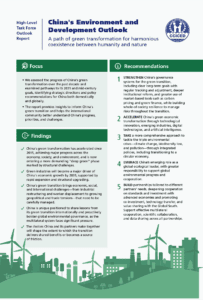
Thematic report 1: “Environmental Governance: Responding to the Three Planetary Crises”
- See report
Thematic report 2: “Green Transition: Shifting Development Paradigms”
- See report
Thematic report 3: “China and the World: Mutual Engagement in Sustainable Development Processes”
- See report
Thematic report 4: “Green Governance: Reforming Institutions and Systems”
- See report
In addition, the HLTF published an executive summary of the interim report in December 2025: CCICED High Level Task Force on China’s Environment and Development Outlook – Executive Summary of Interim Report. The interim report presents high-level reflections and recommendations to guide the final working group and synthesis reports in 2026.
-
Events
High-Level Task Force Kick-Off Meeting
The High-Level Task Force held its kick-off meeting on May 29, 2025. The meeting was attended by around 40 participants, including the Task Force’s leadership and experts, invited experts, and representatives of the CCICED Secretariat and its International Support Office.
Xie Zhenhua, CCICED Vice-Chairperson and China’s former Special Envoy for Climate Change, and Achim Steiner, CCICED Vice-Chairperson and UNDP Administrator, delivered opening speeches. Thereafter, Liu Shijin and Scott Vaughan, Deputy Chairs of the Task Force and CCICED’s Chinese and International Chief Advisors, respectively, introduced the background of the Task Force.
Ren Yong, leader of the Task Force’s core expert group and a CCICED Council Member, introduced the research focus and framework, followed by a discussion among the attending experts.
The discussion emphasized the importance of adopting a systems approach in the research, exploring the relationship between environment and development, and providing in-depth guidance for CCICED’s 8th research phase (2027–2032)—with the broader aim of advancing robust environment and development policies and practices in China and globally.
High-Level Task Force Draft Report Explored in Oxford Meeting
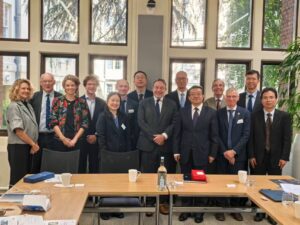
CCICED’s High-Level Task Force held an in-person meeting in Oxford on September 11, 2025. The meeting was attended by the leads of the project’s 4 working groups, a Chinese delegation led by Ren Yong, and invited experts. Achim Steiner opened the session, highlighting the Task Force’s dual purpose of assessing China’s environmental progress and shaping recommendations for the government’s upcoming 15th Five-Year Plan and beyond.
This was followed by remarks from Sir Charles Godfray, Director of the Oxford Martin School, and Ren Yong.
Scott Vaughan, CCICED International Chief Advisor, presented the draft synthesis report—to be published later this year—and the experts explored how to sharpen key messages, better weave in working group insights, and enhance the report’s framing of China’s domestic progress and evolving role in the global green transition. The High-Level Task Force’s final outlook report with comprehensive policy guidance will be published next year.

2025 CCICED AGM Open Forum: Green Transition in China’s 15th Five Year Plan
The CCICED Open Forum on the Green Transition in the 15th Five-Year Plan, held on October 16, 2025, at Beijing’s Diaoyutai State Guesthouse, brought together senior policy-makers, experts, and international partners to discuss how China’s next FYP can advance the country’s ecological and economic transformation. Taking place during the 2025 CCICED Annual General Meeting, the session examined progress over the past decade, set priorities for 2026–2030, and looked ahead to 2035 and carbon neutrality by mid-century.
Opening the forum, China’s Vice Minister Zhao Yingmin highlighted the complex global environment, emphasizing that the green transition must remain a central pillar of Beijing’s high-quality development drive. He urged that the upcoming FYP link immediate actions with the longer-term vision of Ecological Civilization and Beautiful China 2035. Former UN Development Programme administrator and CCICED vice chairperson Achim Steiner welcomed the work of the High-Level Task Force and called for stronger whole-of-government coordination on environment and development policies.
In his keynote, Ren Yong, CCICED council member and lead of the High-Level Task Force expert group, presented previous Chinese achievements, including rapid expansion of clean industries, a maturing national carbon market, and strengthened biodiversity protection through national parks and its “ecological red lines” scheme. He noted that continued investment in low-carbon technologies, nature-positive rules for renewable energy and raw materials supply, stronger data and pricing systems, and more flexible grids will be crucial for translating clean capacity into real emission reductions.
The first panel, chaired by Beate Trankmann, resident representative of the UN Development Programme’s China Office, explored progress and priorities for 2030. Speakers emphasized the importance of integrating social and economic policy, warning that some regions and workers risk being left behind during the transition, as well as the need for just transition pilots, fiscal support for local governments, and incentives that recognize social and environmental outcomes. Participants also discussed China’s global leadership in electric vehicles, batteries, and photovoltaics, suggesting that trade tensions should be converted into cooperation and co-investment.
The second panel, chaired by Jan Bakkes, senior strategic advisor to the director general of the Netherlands Environmental Assessment Agency, focused on outlooks for 2035 and 2050. Experts agreed that foresight should guide decisions rather than predict them and called for integrated policy design linking renewable expansion, biodiversity, air quality, resource extraction, and climate extraction. They also echoed the first panel’s call for cooperation models that turn today’s trade frictions into jobs and investment across markets. Jan Hendrik Dronkers, Dutch secretary-general at the Ministry of Infrastructure and Water Management, emphasized the value of independent institutes for evaluating policies, metrics, and scenarios for delivery.
Across discussions, participants agreed on several priorities: pairing long-term vision with near-term delivery; aligning carbon, pollution, and nature targets with growth and local incentives; centering people and communities in the transition; investing in independent evidence and data systems; and deepening cooperation to de-risk supply chains and keep markets open.
High-Level Task Force Meets in Beijing to Take Stock of Progress and 2026 Plans
The HLTF held a meeting in Beijing and online on February 2-3, 2026, to take stock of progress and plans for 2026. Xie Zhenhua and Achim Steiner delivered opening remarks. The meeting explored the HLTF’s 2026 work plan, a first draft outline of the synthesis report, and interim research findings, while the 4 Working Groups also presented their plans for the year and held in-depth discussions. The HLTF agreed to use qualitative and quantitative methods and adopt an economic, social, and environmental lens across all workstreams. The meeting was chaired by Zhao Yingmin—Deputy Chair of the HLTF, CCICED Council Member, and Chair of the Belt and Road Initiative International Green Development Coalition—and attended by 50 participants including CCICED’s Chief Advisors, members of the HLTF Expert Group, other CCICED Council Members and Special Advisors, invited experts, and representatives from the CCICED Secretariat and its International Support Office.

HLTF Holds Workshop on Low-Carbon Steel to Inform Bespoke Report
On March 25, 2026, the HLTF held a workshop on “Low Carbon Steel to 2035: Pathways and Policy Options” at the Policy Research Centre for Environment and Economy in China’s Ministry of Ecology and Environment, Beijing. The workshop brought together Chinese and international experts, including the expert group lead Ren Yong, to discuss policies for decarbonising the steel sector, spanning both domestic measures and international cooperation. The discussions set the foundation for a short-form report on the topic, which will serve as an input for the main HLTF outlook report.
Oxford Dialogue on “China and the World at Crossroads” Gathers Insights for HLTF Report
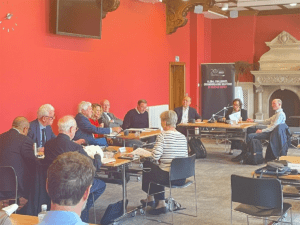
On April 27-28, 2026, Achim Steiner convened a high-level dialogue titled “China and the World at a Crossroads” at the Oxford Martin School, University of Oxford, co-organized with IISD. The event was held in the context of the CCICED HLTF and aimed to complement the project’s existing working groups by gathering broader strategic insights on global implications of China’s green transformation and possible ways to enhance international cooperation. These insights will inform the HLTF’s final outlook report, to be presented later this year at the 2026 CCICED AGM.
HLTF Holds Drafting Session in Geneva
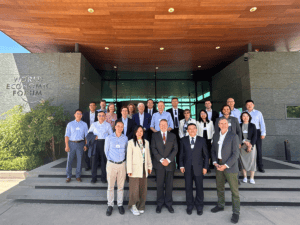
On July 6-7, 2026, the HLTF met in Geneva to review progress and advance the draft synthesis report on China’s Environment and Development Outlook. The HLTF Working Group co-leads presented findings across its four areas: environmental governance and the three planetary crises, shifting development paradigms in the green transition, China’s mutual engagement with the world on sustainable development, and reforming institutions and governance systems. HLTF experts then discussed the draft report in depth, helping to refine its analysis and agree on next steps ahead of its presentation at the 2026 Annual General Meeting. To gather further perspectives, the Chinese delegation met with IISD and other organizations in Geneva before joining a roundtable with European civil society representatives in Brussels.
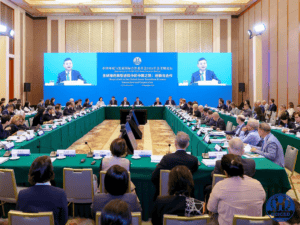
2026 CCICED AGM Open Forum: China’s Path in the Global Green Transition Process: Innovation and Cooperation
On September 28, 2026, nearly 200 participants attended the thematic forum, moderated by CCICED Council Member Zhao Yingmin, to discuss the key outcomes of the HLTF on China’s Environment and Development Outlook. Chinese and international experts reviewed the effectiveness of China’s green transition over the past decade, the opportunities and challenges for advancing the global transition, and China’s relationship with the world.
China’s Minister of Ecology and Environment, Huang Runqiu, attended the forum and emphasised the role of innovation as an engine for green growth. He also stressed the importance of China’s transition not only domestically but also for inclusive, high-quality green development internationally. HLTF co-chairs Achim Steiner and Xie Zhenhua highlighted the HLTF’s work in shaping the future agenda for international cooperation, and the importance of China’s green transition for climate resilience, stable supply chains and energy security.
In a special address, Supreme People’s Court Vice President Yang Linping explained how China’s new Ecological and Environmental Code integrates green and low-carbon development into the legal system. The HLTF core experts and Working Group co-leads presented detailed findings from the Outlook and Working Group reports.
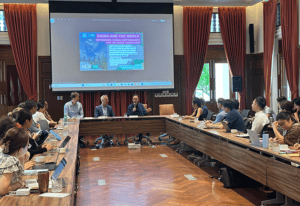
How China Can Drive Green Progress in the Region and the World
On October 7, 2026, more than 40 participants from think tanks, universities, international organizations, and foundations gathered for a CCICED HLTF and ClientEarth event on “China and the World: Rethinking Global Partnerships for the Green Transition.” HLTF working group co-leads Leo Horn-Phathanothai and Beate Trankmann and expert Dimitri De Boer presented the Task Force’s findings and led a discussion on how China can help accelerate the climate transition across Southeast Asia, including through long-term green partnerships. For more on this theme, read CCICED’s new report from our Special Policy Study on Green Development, which explores a potential green data centre partnership between China and Thailand.
- Leadership
-
Core Expert Group
Group Leader:
- Ren Yong, CCICED member and Chief Engineer of China’s Ministry of Ecology and Environment
Advisors:
- Kate Hampton, CCICED Council Member, CEO of Children’s Investment Fund Foundation (CIFF)
- Dirk Messner, CCICED Council Member, President of German Environment Agency (UBA)
- Gim Huay Neo, CCICED Special Advisor, Managing Director of World Economic Forum (WEF)\
- Zhou Guomei, Deputy Secretary-General of CCICED, Director-General of Department of International Cooperation, MEE
- Wang Jinnan, Academician of Chinese Academy of Engineering (CAE)
- Pan Jiahua, Member of Chinese Academy of Social Sciences (CASS)
- Guo Jing, President of BRIGC
- Xia Guang, Vice President of All-China Environment Federation
- Zou Ji, CEO and President of Energy Foundation China
- Mark Halle, Former European Representative, International Institute for Sustainable Development
Working Group co-leads:
- Beate Trankmann, Resident Representative, UNDP China Office
- Wan Jun, Vice President of Chinese Academy of Environmental Planning, MEE
- Zhang Yongsheng, Director General of Institute of Ecological Civilization, Chinese Academy of Social Sciences
- Zhang Haibin, Vice Dean of School of International Relations, Peking University
- Yu Hai, Deputy Director General of Policy Research Center for Environment and Economy, MEE
- Miranda Schreurs, Professor of Climate and Environmental Policy, Technical University of Munich
- Shardul Agrawala, Head, Environment and Economy Integration Division, Organization for Economic Co-operation and Development (OECD)
- Leo Horn-Phathanothai, Affiliate Researcher with the Asia Centre, Stockholm Environment Institute (SEI) and Senior Adviser, Systemiq
- Sarah Cook, Professor and Head of School of Economics University of Nottingham Ningbo
- Thom Wetzer, Associate Professor of Law and Finance, University of Oxford
Coordinators:
- Chen Gang, Secretary General, BRIGC (Chinese Liason)
- Guy Williams, Policy Advisor, IISD (International Liaison)