


In this exclusive deep dive, ClientEarth’s Dimitri de Boer and Boya Jiang—the former a CCICED Special Advisor—analyse China’s new Environmental Code, the country’s first climate legislation, including its key characteristics, implementation challenges, and how it aligns with years of CCICED policy recommendations.
On March 12, China’s National People’s Congress passed the Environmental Code, combining pollution control, ecological protection, and climate action. It forms the first climate legislation in China, underpinning what is already the largest carbon market in the world and providing a guarantee for China’s long-term decarbonization toward its 2060 carbon neutrality goal.
Its adoption sends a strong signal: despite external circumstances, China will continue to prioritise environmental governance.
At ClientEarth, we took a look at what’s new in the Code, and how it aligns with the recommendations of CCICED in the past years.
China’s First Climate Legislation
First, the environmental code integrates over 30 laws into a single umbrella, providing a coordinated and aligned approach to pollution control, ecological protection, and climate change. Very few other countries have done this. The Code is a systematic restructuring of an entire legal field. It’s only the second statutory ‘Code’ to be adopted in China. It reduces overlap and inconsistencies, and addresses key gaps such as climate action and chemical pollution.
Second, the Code is China’s first climate legislation, and contains a total of 57 climate-related provisions. The chapter on ‘green and low carbon development’ lays the foundation for a climate law, which is expected to be drafted in the coming years. China has pledged to peak emissions before 2030. Although the newly adopted 15th Five Year Plan theoretically allows some growth in emissions in the coming years, emissions have been falling or flat for almost two years now, thanks to the rapid increase in power generation from solar and wind. In the coming decades, emissions must continue to fall steadily if China is to reach net zero by 2060. China’s energy transition and industrial decarbonisation imply a total transformation of the economy. A solid legal foundation is necessary to ensure that this process is steady and fair.
The Code clarifies the role of government, business, and society in this process, and underpins key approaches to climate change, such as China’s national carbon market and carbon accounting. The Code also places a strong emphasis on climate adaptation, requiring authorities to formulate adaptation plans, incorporate climate risks into spatial planning, and assess impacts on ecosystems and key sectors.
Third, the Code will facilitate law enforcement, as it elevates key principles and enforcement measures, and streamlines environmental governance. It further expands the role of the judiciary, which had already developed specialized institutions for environmental enforcement.
The Code Matters Beyond China
The adoption of the Code isn’t just good news for people in China, it has important implications for the global green transition.
Implementation of international conventions, from soft law to hard law. The Code provides greater certainty to China’s implementation of conventions such as climate change, biodiversity, and desertification by legally mandating the government. Article 14 specifies that: “The state shall … fulfill the obligations under international treaties concluded or acceded to by the People’s Republic of China…”.By embedding the duty to implement multilateral agreements into a comprehensive environmental code, these obligations gain the force of law, with corresponding mechanisms for enforcement, administrative accountability, and judicial remedy.
China’s emission reductions. For the first time, the national carbon market, the duty of key emitters to comply, and the implementation of National Determined Contributions (NDC) have been stipulated in law. For example, article 1037: “The State shall establish a national carbon emissions trading market. Key greenhouse gas emitting entities included in the national carbon emissions trading market shall fulfil their mandatory emission reduction responsibilities in accordance with national regulations.”
On international climate governance, the Code goes further in Article 1048: “The state upholds the principles of common but differentiated responsibilities, fairness, and respective capabilities, actively participates in and plays a leading role in global climate governance, and promotes the establishment of a fair, reasonable, and win-win global climate governance system.”This is significant, especially in the face of certain other major economies retreating from multilateralism, and global environmental governance. China can be expected to continue to actively engage on environmental matters in key UN mechanisms and bilateral cooperation such as with the European Union, under the Belt and Road Initiative, and in the south–south context.
The Code will also promote new conventions, such as the one on plastics which is currently being negotiated, and the newly ratified Biodiversity Beyond National Jurisdictions agreement, which mainly focuses on ocean biodiversity. The role of China is indispensable in addressing the rapid loss of fish in our oceans.
Chemicals management. Stakeholders around the world are becoming increasingly alarmed about the uncontrolled spread of chemicals, some of which continue to accumulate in the environment and our bodies, and are linked with harmful or poorly understood effects, including to our reproductive systems.
The Code expands the definition of pollutants, to cover a much broader range of chemicals. Article 645 specifies that “the State shall establish a system for the coordinated management and environmental risk control of new pollutants, including persistent organic pollutants. The competent authority for ecological environment under the State Council, in conjunction with relevant departments, shall analyse and assess the situation regarding the environmental risk control of new pollutants, formulate and improve relevant standards, organise and carry out surveys and monitoring, and effectively reduce the environmental risks posed by new pollutants.”Various new regulations on chemical management are in the works. Since China is the world’s largest producer of chemicals, and its goods are consumed all around the world, these efforts matter for all people.
Strong Alignment with CCICED Recommendations
The Code aligns closely with CCICED’s long-standing policy recommendations. As early as 2015, CCICED proactively recommended that China to begin researching an environmental code to resolve inconsistencies across existing statutes and create a “complete, harmonious, and effective legal system.”
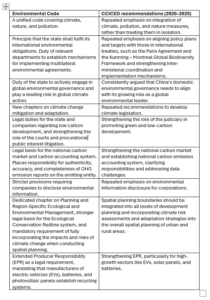
In 2016, the Council expanded this recommendation, suggesting formal feasibility studies and the Code’s inclusion in national legislative planning. The following table details the alignment between CCICED’s recommendations over the past five years and specific components of the Code. The following are just highlights, as the areas of alignment are too many to capture in this article.
Key Implementation Steps
How effective the Code turns out to be will depend largely on its implementation in the coming months and years. We expect the following steps:
- Revisions of existing laws and regulations. Lawmakers will proceed to review and revise relevant laws and regulations to ensure their mutual alignment and consistency with the code. This may include energy-related laws, to align them with the green and low-carbon transition and NDC targets. Local legislatures will also conduct a comprehensive review of local environmental laws and regulations. Provisions that conflict with the Code will be repealed or amended in line with the Code.
- Climate change law. While the Code provides high-level principles for climate action, we are hopeful that a dedicated climate change law will be drafted in the coming years. This has been a consistent recommendation of CCICED, and would provide much needed legal specificity around the key measures for China’s continued decarbonisation in the coming decades.
- Implementing regulations. A series of implementing regulations are also expected to follow, such as regulations on marine environmental protection, chemical management, and environmental monitoring., which would be drafted by the respective ministries. The Supreme People’s Court and the Supreme People’s Procuratorate might also release new judicial interpretations or guidance documents to ensure effective implementation of the Code.
Laws Are Only Meaningful if Enforced
Environmental law enforcement is always challenging, because environmental problems usually affect the public interest rather than a particular company or individual. ClientEarth specialises in environmental law, and has cooperated with various stakeholders in China in the past ten years. Over this period, the Chinese government has actively developed systems to strengthen enforcement of environmental laws.
China now has environmental courts and tribunals, with specialized environmental judges. There are now almost 10.000 environmental judges, who are well equipped to adjudicate cases involving environmental problems. This results in faster case handling, better technical solutions to complex environmental problems, fairer case outcomes, and greater consistency between case rulings across the country.
China now also has a unique system of specialised prosecutors who bring public interest cases for the environment, as well as several other fields of public interest, such as consumer protection, protection of vulnerable groups, and cultural heritage protection. These cases are brought in large numbers—about 50.000 such cases were brought for the environment alone in 2025, down from an average of about 80.000 cases in the period of 2020–2024.
The vast majority of these enforcement actions compel government departments to rectify environmental problems through the dutiful implementation of environmental laws. So far, the prosecutors have focused mainly on tackling pollution and harm to ecosystems. The Code allows them to actively expand their work into other fields of global concern, such as marine protection, low carbon development, and harmful chemicals.
The Code establishes dedicated liability provisions for violations of green and low-carbon development requirements, reinforcing the enforceability of climate-related obligations. For instance, Article 1037 of the Code that major greenhouse emitters are responsible for the authenticity, accuracy, and completeness of their emission statistics and annul emission reports. Such new provisions further empower China’s specialised environmental judges and prosecutors to play a greater role in enforcing climate-related rules.
In addition, the Code comes on top of a dedicated law on procuratorial public interest litigation, which is currently being drafted and is expected to further boost the capabilities of the prosecutors. Together, these mechanisms suggest that China’s climate governance framework is supported not only by policy commitments but also by an increasingly robust legal and judicial enforcement infrastructure, providing a strong legal guarantee to the implementation of the Code.
While the Code marks a significant milestone in China’s environmental rule of law, some concerns remain that need to be addressed during its implementation. For instance, the final version of the Code no longer mentions standing to bring public interest lawsuits when “the ecological environment is at significant risk of being damaged”, i.e. the preventive principle which underpinned the well-known “Green Peacock” case. The case, ruled in 2020, was a landmark victory for Chinese environmental groups that successfully halted the construction of a USD 500 million hydropower dam in Yunnan Province, to protect the country’s last major habitat for the endangered bird. It was China’s first preventive environmental public interest lawsuit, which set an important precedent: Illegal developments in ecological conservation areas would no longer be tolerated, and courts could rule to prevent ecological harm before it occurs.
Also, the Code specifies standards for filing a public interest case by requiring prosecutors or local non-governmental organizations (NGOs) to provide evidence of the extent of environmental damage, the cost of environmental losses, and the cost of restoration.
This appears to place a heavier burden of proof on the plaintiff and could further reduce the number of cases brought by NGOs, who have very limited resources. However, in other articles the Code clearly emphasises the preventive principle and encourages the role of NGOs. Therefore, we will need to see how the Code is applied when public interest lawsuits are brought to China’s environmental courts. This may also be the subject of clarification in future judicial interpretations.
New Chapter for Environmental Law in China
The adoption of the Environmental Code marks a new stage in China’s environmental rule of law. By consolidating fragmented environmental laws into a single, coherent Code, it strengthens the legal basis for pollution control, ecosystem protection and climate action at a time when China is undergoing a profound economic transformation.
The Code also sends a clear message internationally. At a time when some countries are retreating from multilateral environmental governance, China has chosen to elevate environmental protection and climate action into its top legal architecture. The Chinese government now has a clear legal duty to remain actively engaged in global environmental efforts.
Ultimately, the effectiveness of the Code will depend on its implementation. If supported by strong enforcement, regulatory alignment and future legislation such as a dedicated climate law, it will play a crucial role in enhancing China’s environmental governance—and contribute significantly to the global green transition.
The views expressed are those of the authors and not necessarily those of CCICED