


“2025 may have marked a historical turning point. At the AGM this year, I noted a consensus that China has become a global leader in upholding global momentum in the green transition,” Dimitri de Boer, Director for ClientEarth in China and CCICED Special Advisor, writes as he reflects on the key themes and takeaways from the 2025 AGM.
Key takeaways:
-
-
- China as a Green Superpower: By 2025, China has solidified its position as a global leader on the green transition, a trend only set to continue.
- Resilience Against Policy Regression: China’s climate policy consistency provides a stable environment for green investment.
- Ecological Civilization Advances: China’s green transition is rooted in the philosophy of “Ecological Civilization”, mainstreaming environmental commitments across the economy, society, and culture.
- Two-way Collaborative Exchange: Strategic partnerships between China and international stakeholders are essential to scaling global climate solutions.
-
The 2025 China Council for International Cooperation on Environment and Development (CCICED) Annual General Meeting (AGM) was different from any previous year. For the first time, it was clear to me that China is now the greatest positive force in the global green transition. International participants got a boost from the ongoing momentum in areas like clean energy, electric mobility, pollution control, and nature protection, which, for many, contrasted with slowing progress or policy regression in their own countries. Many came away with renewed confidence and tangible ideas on how to make big things happen for the world, in partnership with China.
I won’t try to summarize all the important subjects that were discussed at the AGM, or the powerful recommendations to China’s State Council, which are now entering their final stage. Instead, I’ll share some key takeaways from my many conversations, including some which took place over drinks in the lobby of the Diaoyutai State Guest House and the old courtyard of Leo Horn, an expert working on CCICEDs High-Level Task Force, not too far from there.
That courtyard takes us back to the Tang Dynasty, a time when China was the world’s most advanced center for technology and governance, philosophy and art, finance, and trade. In the past centuries, however, China has found itself outcompeted in many areas, and it has been working hard to catch up.
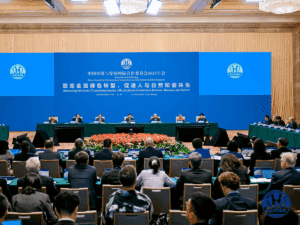
2025 may have marked a historical turning point. At the AGM this year, I noted a consensus that China has become a global leader in upholding global momentum in the green transition, which matters for all life on earth. It was already the undisputed leader in green technologies. China is now not just an indispensable partner in the global green transition; it is leading it.
And this leadership is expected to continue. Vice Premier Ding Xuexiang and Minister Huang Runqiu reaffirmed the political commitment to achieving China’s newly set climate goals, as well as to staying the course on green and high-quality development and contributing even more to global environmental governance. This decision reflects a long-term perspective, as it is made in the face of strong economic headwinds at home and complex international geopolitics, with countries pulling away from multilateralism and global environmental agreements. But it clearly makes sense too—China’s green sectors are estimated to account for 11.7% of GDP in 2025, an increase of CNY 5 trillion compared to 2020. China added more solar and wind power in 2024 than the rest of the world combined, providing low-carbon energy and economic security. Carbon emissions appear to be peaking, with the successful decoupling of emissions from continued growth in economic activity and power demand. For China, economic and environmental objectives are now clearly intertwined.
“For the first time, it was clear to me that China is now the greatest positive force in the global green transition.”
There were a few more important takeaways:
- Green diplomacy. I heard many ideas about how China could strengthen its green diplomacy, as it would benefit China, partnering countries, people, and the planet. This implies a need for dedicated resources and capacity, and even closer coordination between environmental, economic, and foreign affairs departments. It’s no coincidence that 2 days after the AGM, the first Belt and Road Initiative (BRI) Green Innovation Conference took place, hosted by the BRI Green Development Coalition, under the new leadership of former vice-minister Zhao Yingmin.
- Sharing economic benefits. China’s green technologies are needed to achieve the targets of the Paris Agreement and rapid, inclusive green development. Other countries, especially emerging economies, have an opportunity to partner with Chinese companies to play a greater role in the new, green economy. This would boost political support for the green transition in those countries, as they would get more benefits from the green economy through high-quality jobs, access to advanced technologies, and leapfrogging to true energy security.
- Ocean conservation and the blue economy. This year’s AGM had a great focus on the ocean, with the open forum on Land-Sea Coordination drawing the greatest interest from participants. This follows the UN Ocean Conference in Nice, with a recognition that much more work is needed to achieve the marine targets set for 2030 in the Kunming–Montreal Global Biodiversity Framework to realize the potential of emerging blue economy opportunities.
- Adaptation. 2024 was the warmest year on record, exceeding the 1.5°C threshold for the first time, as recognized by China’s official climate adaptation report issued in June. Many advisors recommended that, given the rapid increase in climate impacts, CCICED should prioritize research on climate adaptation in the coming years.
- Gender. CCICED has worked on mainstreaming gender issues for several years now. This effort got a major push from President Xi Jinping, who made an important speech about advancing gender issues several days before the start of the AGM.
- The High-Level Task Force. This year saw the creation of a new priority study conducted by a high-level task force comprised of top Chinese and international experts. Its purpose is to take stock of progress in the past 10 years and make recommendations for China’s green policies for both 2035 and 2050. This is very timely given the need to formulate the 15th Five-Year Plan and make decisions that will set the course for the medium and long terms, in the face of an extremely complex and unpredictable external environment. A key decision is the degree to which China should continue to commit to the green transition and champion it globally.
Looking ahead, CCICED will conclude the current phase of its Five-Year Plan in 2026 and begin Phase 8. China’s green leadership changes the dynamics in CCICED and the way in which it could be most impactful. In the initial decades of the council, international members and advisors focused their recommendations on addressing environmental problems within China. Around 2015, an important new focus was added: advising the Chinese government on China’s role in the world, such as greening China’s overseas investments and rapidly growing supply chains. Great progress has been made, and I expect those topics to continue to be a priority.
In the coming years, given China’s demonstrated success, I expect that international members and advisors will take a much greater interest in what other countries can learn from China’s approaches, as well as how cooperation and partnerships with China could benefit their green development or green transition, thereby setting up a new, genuine two-way collaborative exchange.
China now has specialized environmental judges and prosecutors, and their leaders again spoke at the AGM. China’s ecological conservation redlines are another inspiring example: they are a scientifically sound way of making space for biodiversity, disaster risk reduction, and ecosystem services.
It is becoming clear that concepts such as “ecological civilization” are more than mere slogans; they are underpinned by steadfast political commitment and are being systematically mainstreamed into the legal system, governance at all levels, the economy, culture, and society. These and other approaches really deserve to be studied abroad.
The views expressed are those of the author and not necessarily those of CCICED.