


Key takeaways
- China has launched a set of marine protection and fisheries laws, policies, and enforcement initiatives in 2026.
- By sustaining this momentum, consistent enforcement, and sharing what works, China is poised to play a growing role in global oceans governance, including role on implementing the newly adopted “High Seas Treaty”.
- CCICED has conducted extensive research and policy development on sustainable ocean governance at home and abroad since 2009.
China is turbocharging marine protection with a series of newly adopted laws, fisheries policies, and enforcement initiatives all launched in 2026. On the back of domestic action and stricter management of distant water fisheries, China is poised to play a leading role in advancing global marine governance and implementing the newly adopted “High Seas Treaty”. Dimitri de Boer, ClientEarth’s China Director and CCICED Phase VII Special Advisor, and Jiang Boya, lawyer at ClientEarth, unpacks in this CCICED exclusive.
Ocean conservation has been a major focus of CCICED’s work since 2009. Various studies and exchanges have been recommending actionable steps the Chinese government can take to strengthen ocean conservation, both within China’s domestic waters and in activities on the high seas, such as distant-water fisheries.
With the first Conference of the Parties to the Agreement on the Conservation and Sustainable Use of Marine Biological Diversity of Areas beyond National Jurisdiction (BBNJ Agreement), also known as the High Seas Treaty, coming up in New York in January 2027, and China’s recent bid to host its secretariat in Xiamen, this work is extra timely now.
The BBNJ Agreement, adopted in 2023 and in force since 2026 under the UN Convention on the Law of the Sea, aims to protect and sustainably use marine biodiversity beyond national borders through four main areas: fair sharing of the benefits from marine genetic resources, area-based management tools such as marine protected areas, environmental impact assessments for ocean activities, and capacity-building and technology transfer for developing countries.
We are pleased to observe that over the course of this year, China has taken key steps to improve fisheries oversight, strengthen the legal basis for marine protection, and involve law enforcement agencies to ensure implementation and enforcement. Together, these developments give China a much stronger basis to contribute to the agreement’s implementation.
“The impact of China’s new laws and policies will ultimately depend on how consistently they are implemented and enforced.”
Figure 1. Progress in 2026: A Series of Laws, Policies and Enforcement Initiatives on Marine Conservation
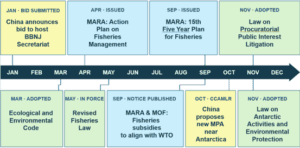
China’s progress in 2026 (yes, all of this happened in 2026!):
- A stronger legal basis for marine biodiversity protection. The Ecological and Environmental Code, adopted in March and in force since August, calls for stronger marine biodiversity surveys, monitoring and assessment, protection and restoration of important marine ecological corridors, and requirements to fulfill obligations under international treaties, including the BBNJ Agreement. The revised Fisheries Law, which took effect in May this year, strengthens the framework for conserving fishery resources and regulating fishing activity. On top of that, China adopted the Antarctica Activities and Environmental Protection Law in November, which also covers marine biodiversity protection in the surrounding Southern Oceans. Read together, these laws provide a solid basis for aligning fisheries management and marine ecosystem protection.
- Closer oversight of distant-water fishing. In April, the Ministry of Agriculture and Rural Affairs (MARA) issued an enforcement plan that adopts a “zero-tolerance approach” to tampering with or disabling vessel position-monitoring equipment, using prohibited gear, catching protected species, exceeding catch quotas, and shark finning. The plan also emphasizes strengthening supervision and law enforcement in distant-water fishing, and calls for closer monitoring of vessels undergoing ownership transfers or operating without valid project approvals. In September, MARA’s 15th Five-Year Plan for National Fisheries Development (2026-2030) set a broader direction for the sector. It calls for keeping fishing pressure within what fish stocks can sustain, strengthening oversight of distant-water fisheries, and stepping up China’s participation in international fisheries governance. It also promotes more selective fishing methods and calls for strict limits on the harvest of aquatic organisms for use as feed.
- Aligning fisheries subsidies with international rules. In September, MARA and the Ministry of Finance issued a joint notice on fisheries support under the 15th Five-Year Plan. The notice calls for the full implementation of the World Trade Organization (WTO) Agreement on Fisheries Subsidies and requires domestic subsidy policies to comply with WTO rules. It also calls for reforms to support for distant-water fisheries in light of ongoing WTO negotiations. The notice sets out prohibitions on subsidies linked to illegal, unreported and unregulated (IUU) fishing, fishing of overfished stocks, and fishing in areas that fall outside both coastal-state jurisdiction and the competence of a relevant regional fisheries management organization or arrangement.
- China Steps Up Its Efforts to Protect the Southern Ocean. At the October meeting of the Commission for the Conservation of Antarctic Marine Living Resources (CCAMLR), China submitted a proposal for a marine protected area off East Antarctica. In addition, the mentioned Antarctic Activities and Environmental Protection Law, provides a domestic framework for regulating Chinese activities in Antarctica, protecting its environment, and implementing China’s obligations under relevant Antarctic treaties.
CCICED has also examined these issues through its Special Policy Studies (SPS), particularly the Nature and Oceans SPS. As part of this work, Chinese and international experts have explored steps China could take to support the implementation of the BBNJ Agreement and strengthen fisheries governance. SPS Oceans, for example, recommended using vessel tracking data and catch records to guide port inspections and help fisheries authorities investigate suspected violations.
CCICED built on this work in its 2026 annual recommendations to the Chinese government, submitted following this year’s Annual General Meeting (AGM), held in Beijing on September 27-29, suggesting stronger compliance and traceability in distant-water fisheries, comparable port controls for domestic fleets, closer coordination between marine spatial planning and fisheries management, and alignment of fisheries subsidies with international rules.

Enforcing China’s New Marine Protection Measures
China’s recent laws and policies have created strong momentum for marine biodiversity protection. However, enforcement of fishery sustainability rules is notoriously challenging in any jurisdiction, as the activities take place far out at sea, and fishery industry lobbies are often powerful. The impact of China’s new laws and policies will ultimately depend on how consistently they are implemented and enforced, making the role of law enforcement departments particularly important.
At the 2026 CCICED AGM, China’s Deputy Prosecutor-General Zhang Xueqiao reaffirmed that China’s procuratorates will actively support China in fulfilling its obligations under the BBNJ Agreement and in putting the agreement into practice. China has developed a special mechanism for environmental law enforcement, empowering prosecutors to bring environmental public interest litigation. In 2025, around 50 000 legal challenges were brought by the prosecutors in China, with the vast majority aiming to ensure government departments implement their legal duties to protect the environment. Over the past 10 years, this system has proven particularly effective in ensuring compliance with laws on pollution control, ecosystems and biodiversity protection.
On November 6, during World Ocean Week in Xiamen, the Supreme People’s Procuratorate (SPP), Xiamen University and ClientEarth jointly convened the International Symposium on Innovative Judicial Protection of Marine Biodiversity, bringing together prosecutors and legal experts from China and abroad to discuss how procuratorial work can strengthen marine biodiversity protection and support BBNJ implementation. The Deputy Prosecutor-General highlighted the role of prosecutors in overseeing regulators to ensure they fulfil their legal duties in marine protection.
One immediate example is MARA’s “zero-tolerance” policy on distant-water fisheries violations, including tampering with, or deliberately switching off vessel position monitoring equipment. This is a critical provision – real-time location tracking data would reveal many types illegal behaviour, such as entering another country’s exclusive economic zone illegally, fishing outside of season, or fishing inside an MPA. Where vessel tracking data suggest such violations, or that monitoring equipment may have been off, prosecutors can check whether the responsible authorities have investigated and taken appropriate action.
China’s prosecutors can also cooperate with their counterparts in other countries, to follow up on suspected illegal cross-border activities, such as vessels entering an exclusive economic zone without a valid permit.
In another very timely development, on November 6, the same day as the Xiamen symposium, China also adopted the Procuratorial Public Interest Litigation Law. The law further empowers the prosecutors, giving them a clearer statutory basis for protecting the public interest, including in cases affecting marine biodiversity.
The Supreme People’s Procuratorate and their local counterparts can build on this by coordinating ministries and local government departments responsible for the environment, natural resources and fisheries, ensuring the consistent and correct implementation of relevant laws and policies, facilitating multi-stakeholder cooperation and civil society participation, thus systematically enhancing China’s credibility and institutional influence in marine biodiversity conservation and ocean governance.
“These steps send a clear signal ahead of the first BBNJ COP…China is already using its domestic laws and institutions to advance its primary objective: protecting marine biodiversity.”
Keeping Up the Momentum and Leading by Doing
China’s recent measures mark a huge step forward in how it protects marine biodiversity in its own waters and regulates its activities on the high seas. Stronger vessel monitoring can help fisheries authorities detect suspected violations, revised subsidy rules can keep public funds from supporting illegal fishing, proposal of MPAs can safeguard critical habitats, and – very importantly – the procuratorial public interest litigation system can help ensure that regulators investigate and act on suspected breaches.
These steps send a clear signal ahead of the first BBNJ COP. While parties work out how the Agreement will operate, China is already using its domestic laws and institutions to advance its primary objective: protecting marine biodiversity.
This record of action strengthens Xiamen’s bid to host the BBNJ Secretariat.
By sustaining this momentum, enforcing these measures consistently, and sharing what works, China is poised to play a leading role in implementing the BBNJ Agreement and advancing global marine governance.
China can demonstrate what effective oversight of distant-water fleets looks like in practice, setting strong examples which will hopefully inspire all countries to do better together.
The views expressed are those of the authors and not necessarily those of CCICED