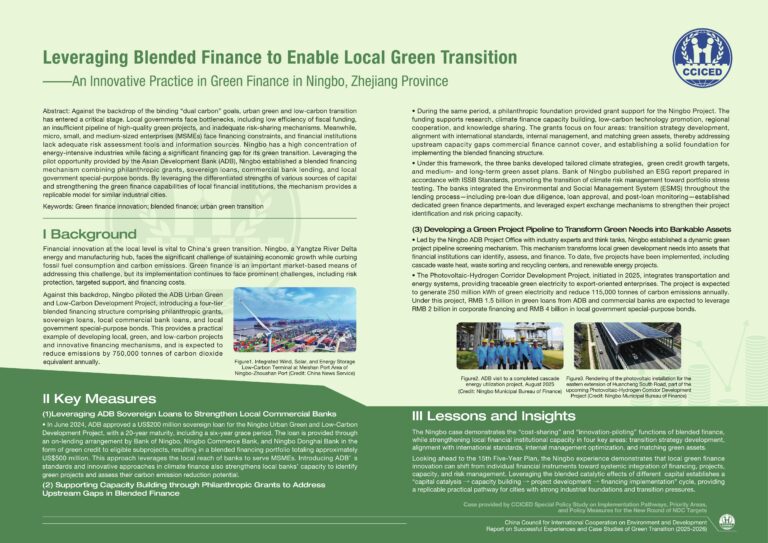
Blended Finance Supports Green Transition in Ningbo
By blending grants, sovereign loans, bank lending and local bonds, Ningbo turned a green-finance gap into a replicable model for industrial cities.
This interactive portal showcases a diverse range of green transition case studies from CCICED’s research projects. Through detailed reports and fact sheets, the portal showcases initiatives such as greening data centres in Indonesia, protecting biodiversity with environmental DNA on Nan’ao Island, and financing low-carbon transitions in Chongqing, Guangdong, and Ningbo.
Circular Solutions in the Chemical Industry
Jinsu Town, Wutongqiao, Leshan, Sichuan, China View Case StudyMonitoring Island Biodiversity using environmental DNA
Nan'Ao, Shantou, Guangdong, China View Case Study
By blending grants, sovereign loans, bank lending and local bonds, Ningbo turned a green-finance gap into a replicable model for industrial cities.
Pan’an County harmonizes species protection with economic growth as China’s first "biodiversity-friendly city" using a high-tech "industry brain" for Chinese medicine. Learn more.
Fuhua Tongda Chemical Co. has transformed linear production into a high-efficiency circular chain, achieving near-total phosphorus utilization through "Elemental Economics." Read the case study.
Community-led business models in India, Mexico, Brazil, and Peru demonstrate how indigenous knowledge and organic certification can resolve the conflict between conservation and development. View the impact.
Chongqing has empowered heavy industries to decouple growth from carbon through its "Green Finance Connect" digital platform and innovative carbon-linked loans. Discover the strategy.
Zichuan District has transformed a resource-depleted industrial area into an integrated "energy + industry" complex by repurposing abandoned mines for solar-powered farming and pumped storage. Explore the model.
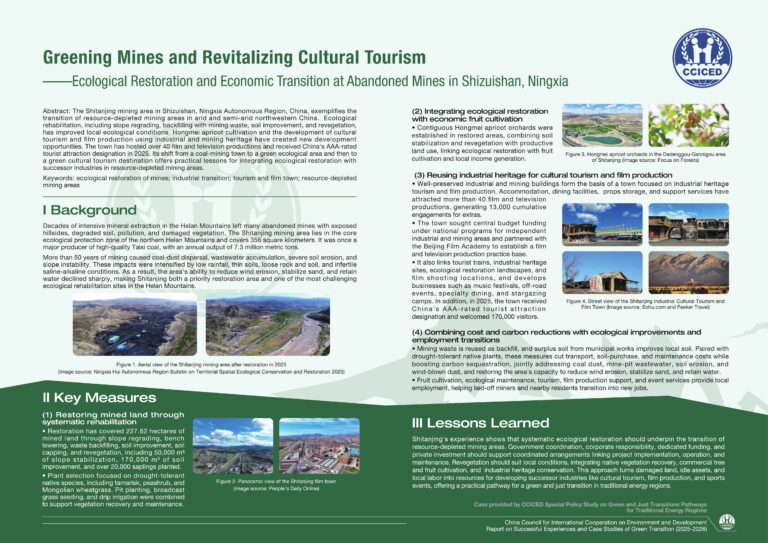
A scarred coal-mining town in Ningxia has reinvented itself with restored land, apricot orchards and a film-set tourism boom.
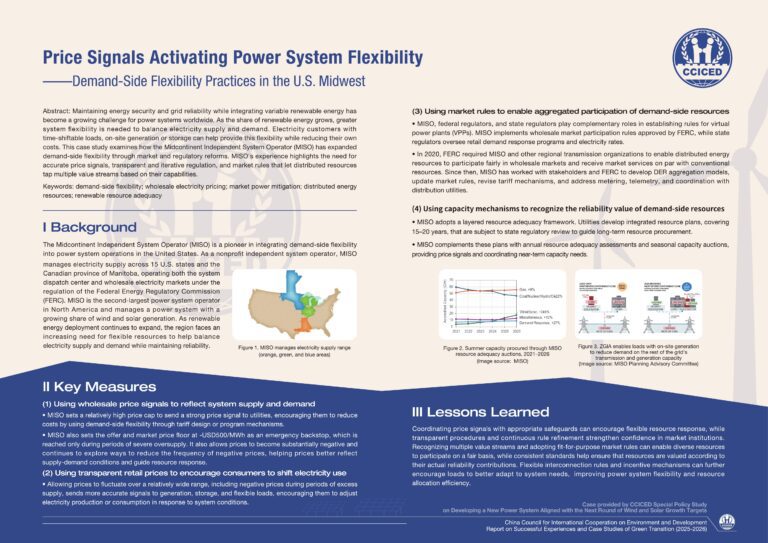
With the right price signals and fair market rules, power users become a grid’s flexible asset instead of just its demand.
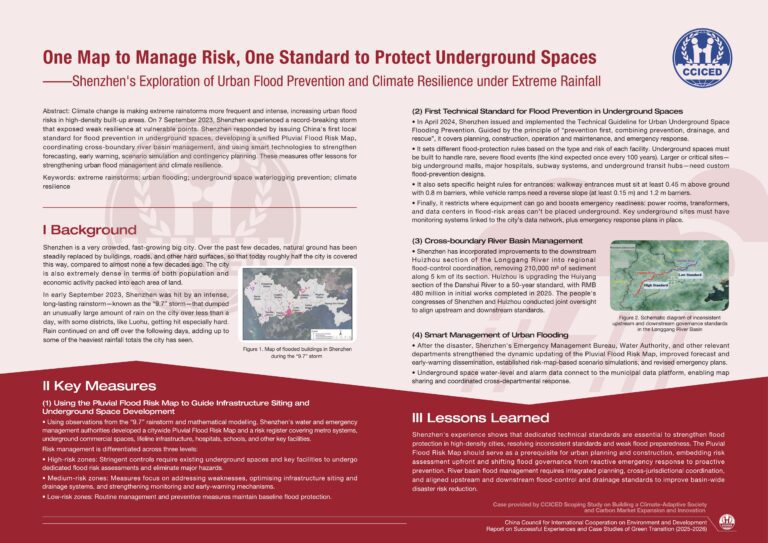
After a record storm, Shenzhen mapped its flood risk and wrote China’s first local standard to keep underground spaces dry.
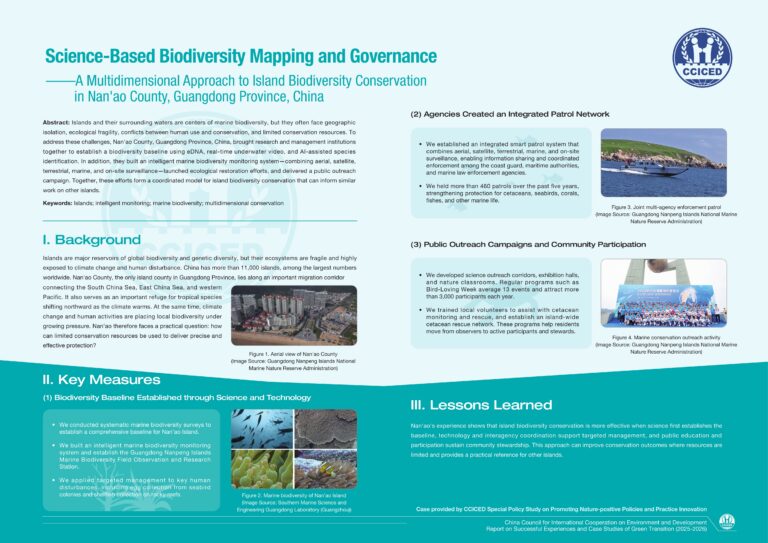
With the help of environmental DNA (eNDA), underwater video, and AI-powered species identification, Nan’ao is protecting its unique island biodiversity despite limited resources.
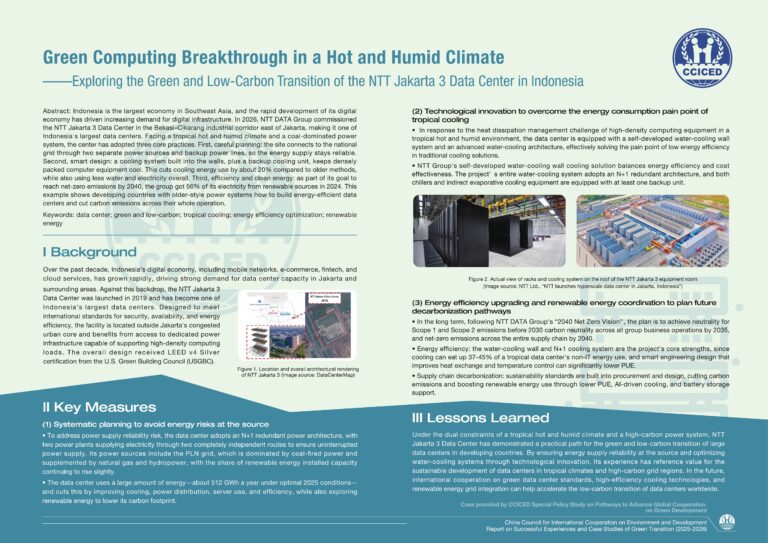
Built for tropical heat and a coal-heavy grid, this Indonesian data center shows how to cool smarter and run cleaner.
In Wuyuan, the endemic blue-crowned laughingthrush has been protected through scientific ecological restoration while boosting the local economy through bird-watching tourism. See the impact.
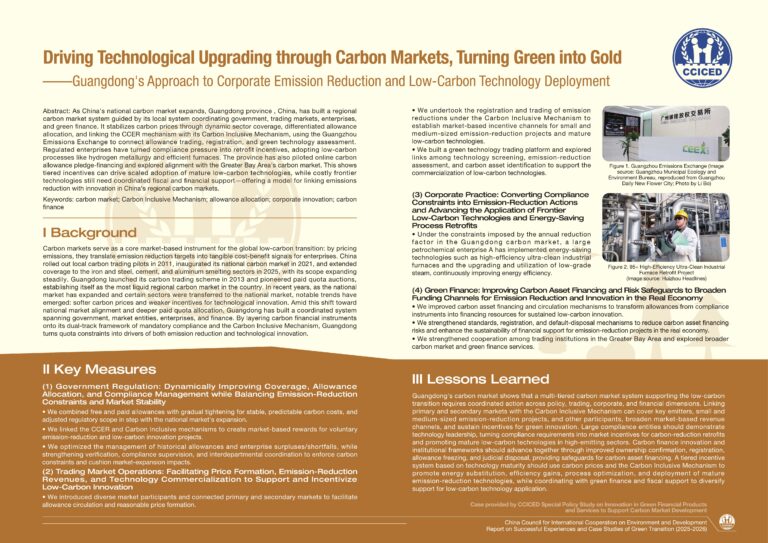
Guangdong’s carbon market turns compliance pressure into profit, rewarding firms that swap in low-carbon technology.
Suzhou has successfully met record energy demand through developing large-scale energy storage and China's largest virtual power network for electric vehicles. Explore the model.
Ant Consumer Finance has issued 130 billion yuan in green loans to over 100 million users, using artificial intelligence (AI) to incentivize low-carbon purchasing habits. View the results.